

Child Psychiatry TodayChild Psychiatry Today
Notification Show More
Font ResizerAa
  • Home
  • Development
  • Conditions
    • Addictions
    • ADHD
    • Aggression
    • Anxiety
    • Attachment Disorders
    • Autism Spectrum Disorders
    • Bipolar Disorder
    • Conduct Disorder
    • Delirium
    • Depression
    • DMDD (Disruptive Mood Dysregulation Disorder)
    • Eating Disorders
    • Intellectual Disability
    • Learning Disorders
    • Medical Conditions
    • OCD
    • Personality Disorders
    • Psychiatric Emergencies
    • Schizophrenia and Psychosis
    • Sleep Disorders
    • Somatoform Disorders
    • Trauma and Stress
  • Family & School
    • Adoption
    • Bedwetting
    • Bullying
    • Caffeine Use
    • Child Abuse
    • Chores
    • Divorce
    • Domestic Violence
    • Driving
    • Family Alcohol Use
    • Guns and Firearms
    • Parenting Styles
    • Peer Pressure
    • Racism
    • Religion
    • Sports
    • Stepfamily
    • Suicide
    • Teenage Pregnancy
  • Digital Life
    • Internet Use and Social Media
  • Treatment
  • Research
    • Books
    • Research News
  • About
  • Newsletter
  • Editorial
Reading: When a Child’s Behavior Means Different Things at Home and School
Share
Child Psychiatry TodayChild Psychiatry Today
Font ResizerAa
Search
  • Home
  • Development
  • Conditions
    • Addictions
    • ADHD
    • Aggression
    • Anxiety
    • Attachment Disorders
    • Autism Spectrum Disorders
    • Bipolar Disorder
    • Conduct Disorder
    • Delirium
    • Depression
    • DMDD (Disruptive Mood Dysregulation Disorder)
    • Eating Disorders
    • Intellectual Disability
    • Learning Disorders
    • Medical Conditions
    • OCD
    • Personality Disorders
    • Psychiatric Emergencies
    • Schizophrenia and Psychosis
    • Sleep Disorders
    • Somatoform Disorders
    • Trauma and Stress
  • Family & School
    • Adoption
    • Bedwetting
    • Bullying
    • Caffeine Use
    • Child Abuse
    • Chores
    • Divorce
    • Domestic Violence
    • Driving
    • Family Alcohol Use
    • Guns and Firearms
    • Parenting Styles
    • Peer Pressure
    • Racism
    • Religion
    • Sports
    • Stepfamily
    • Suicide
    • Teenage Pregnancy
  • Digital Life
    • Internet Use and Social Media
  • Treatment
  • Research
    • Books
    • Research News
  • About
  • Newsletter
  • Editorial
Follow US
Copyright © 2014-2023 Ruby Theme Ltd. All Rights Reserved.

When a Child’s Behavior Means Different Things at Home and School

Development & AssessmentFamily, School & Social Context

When a Child’s Behavior Means Different Things at Home and School

ChildPsy Today
By
ChildPsy Today
Last updated: June 23, 2026
5 Min Read
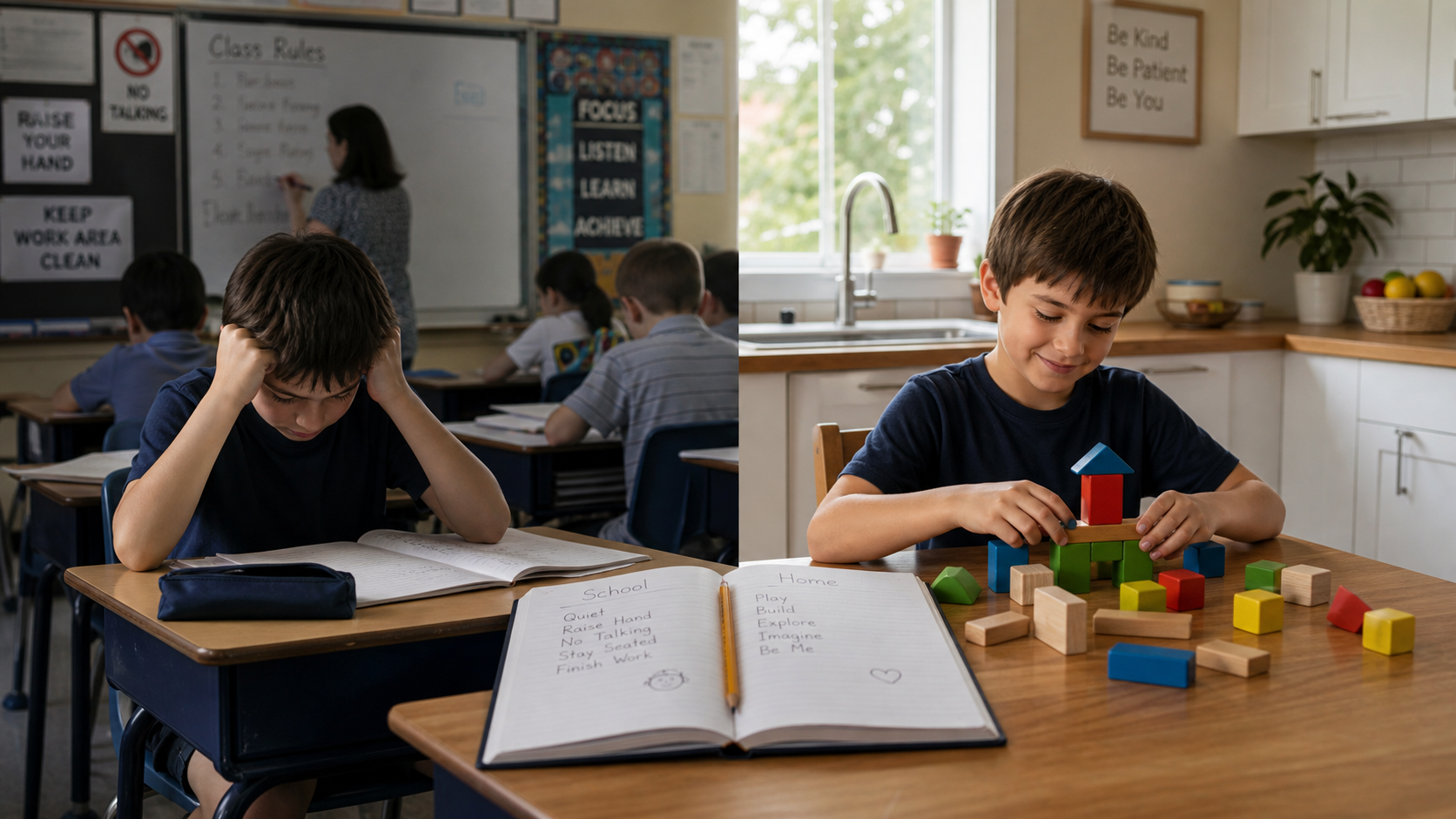
The same child seen in a classroom and at home, showing how context changes the meaning of behavior.
SHARE
Medical note: Educational information only. This article does not replace clinical evaluation, diagnosis, or treatment.

A child is "fine at school" but explosive at home. Another is calm at home but disruptive in class. A third speaks freely with friends but freezes with adults. These differences are often treated as contradictions. Clinically, they are clues.

A behavior does not carry its meaning on its face. It gets its meaning from context: where it happens, who is present, what came before it, what the child expects, and what the behavior helps the child escape or achieve.

Why one setting is never enough

Williams and Hill repeatedly emphasize that children are easy to misunderstand if adults rely on a single viewpoint. Parents see one child. Teachers see another. Clinicians see a third. The child may have a fourth view, which is often the most private and the least heard.

None of these views is automatically false. Each is partial.

A child who collapses after school may have spent the day masking anxiety or sensory overload. A child who behaves well at home but disrupts class may be overwhelmed by noise, transitions, reading demands, or peer status. A teenager who seems depressed with parents but animated alone may be protecting a private social life, hiding conflict, or reacting to a particular relationship.

Common context traps

Adults often fall into predictable traps:

  • "If he can do it there, he can do it here." Sometimes true, sometimes not.
  • "She is only difficult with me, so she must be choosing it." Maybe, but maybe that relationship is where stress finally comes out.
  • "The school says he is fine, so there is no problem." School may not see the cost of coping.
  • "Parents say she is impossible, so school must be missing something." Parents may be seeing exhaustion, fear, or family conflict.

The right response is not to pick a winner. It is to map the pattern.

What to map

Question Why it matters
Where does the behavior happen? Problems tied to one setting often point to demands, relationships, or sensory triggers.
When did it start? Timing may reveal transitions, losses, bullying, illness, puberty, or school changes.
What makes it better or worse? Patterns are often more useful than labels.
What skill is being demanded? Reading, waiting, shifting attention, tolerating uncertainty, or managing shame may be the real issue.
What does the child say? The child’s account may reveal fear, embarrassment, loyalty, or hidden pressure.

What parents and schools can do

Start with a shared log for two weeks. Keep it brief: time, setting, trigger, behavior, adult response, recovery. Look for patterns before conclusions. If the child is old enough, include their view without turning the log into a trial.

Then test small changes: reduce one demand, change one transition, add one predictable break, move one seating arrangement, or alter the timing of homework. If the pattern changes, you have learned something.

For more, see What Adults Miss When They Interpret a Child’s Behavior and Family Dynamics and Children’s Mental Health.

Source notes

Book source: Williams J, Hill P. The Art of Child and Adolescent Psychiatry. Cambridge University Press. Volume 1, Assessment, section A: The Child. Chapters A1-A2, pp. 5-21, especially the emphasis on normality, context, and learning about the individual child.

External sources used for context: CDC developmental monitoring, NIMH child and adolescent mental health, AAP guidance for families and media routines, and BMJ evidence-based medicine principles.

Verification note: Original prose; no clinical claim is based on a copied passage.

TAGGED:child assessmentchild developmentChild PsychiatryChildPsy evidenceclinical assessmentparents and teachersschool behaviorThe Child: Assessment Before Diagnosis

Sign Up For Daily Newsletter

Be keep up! Get the latest breaking news delivered straight to your inbox.

Weekly newsletter

One short email each week.

By signing up, you agree to our Terms of Use and acknowledge the data practices in our Privacy Policy. You may unsubscribe at any time.
Share This Article
Facebook Copy Link Print
ChildPsy Today
ByChildPsy Today
ChildPsy Today publishes AI-assisted, source-checked editorial content on child and adolescent mental health. Articles are educational and are not a substitute for professional assessment, diagnosis, or treatment.
Previous Article A child using colorful paper collage during a creative arts therapy activity How Creative Arts Therapies Can Support Children
FacebookLike
XFollow
PinterestPin
InstagramFollow

Subscribe Now

Subscribe to our newsletter to get our newest articles instantly!

Weekly newsletter

One short email each week.

Most Popular
The same child seen in a classroom and at home, showing how context changes the meaning of behavior.
When a Child’s Behavior Means Different Things at Home and School
June 23, 2026
A child using colorful paper collage during a creative arts therapy activity
How Creative Arts Therapies Can Support Children
July 1, 2026
A balanced family meal with fresh vegetables and a child at the table
Nutrition and Children’s Mental Health: What Families Should Know
July 1, 2026
A teenager holding a smartphone with a reflective expression in soft evening light
Social Media and Adolescent Mental Health: A Balanced Guide for Families
July 1, 2026
A parent kneeling to speak calmly with an upset child in a living room
Parenting Children with Behavioral Challenges
June 30, 2026

You Might Also Like

Illustration for article: Recognizing Attachment Disorders in Children and Teenagers
Conditions & SymptomsAttachment Disorders

Recognizing Attachment Disorders in Children and Teenagers

11 Min Read
Treatment options for disruptive mood dysregulation disorder
DMDD (Disruptive Mood Dysregulation Disorder)

Treatment Options for Disruptive Mood Dysregulation Disorder

20 Min Read
A diverse autistic child focused on a detailed drawing, not a stereotype
Conditions & SymptomsDevelopment & Assessment

Autism Spectrum Disorder in Children

4 Min Read
Family standing in a lush green field with tractor.
Parenting Styles

How Parenting Styles Impact Children’s Engagement

10 Min Read

Weekly child mental health briefing

One concise email each week with new and updated Child Psychiatry Today guides. No spam, no profiling, unsubscribe anytime.

Weekly newsletter

One short email each week.

Child Psychiatry Today Child Psychiatry Today

Child Psychiatry Today publishes AI-assisted, source-checked articles on child and adolescent mental health for families, educators, and clinicians. Educational content only; not a substitute for professional care.

Core Topics

  • ADHD
  • Anxiety
  • Autism spectrum
  • Depression
  • OCD

Resources

  • Development & assessment
  • Family, school & social context
  • Digital life & media
  • Treatment & care
  • Research & evidence

Editorial

AI-assisted, source-checked content. No fictional medical reviewers.
Editorial Process
  • About
  • Contact
  • Privacy policy

If a child may be in immediate danger, contact local emergency services or a qualified crisis service.

Welcome Back!

Sign in to your account

Username or Email Address
Password

Lost your password?